Monday, June 7, 2010

Malaria and a Theology of the Future


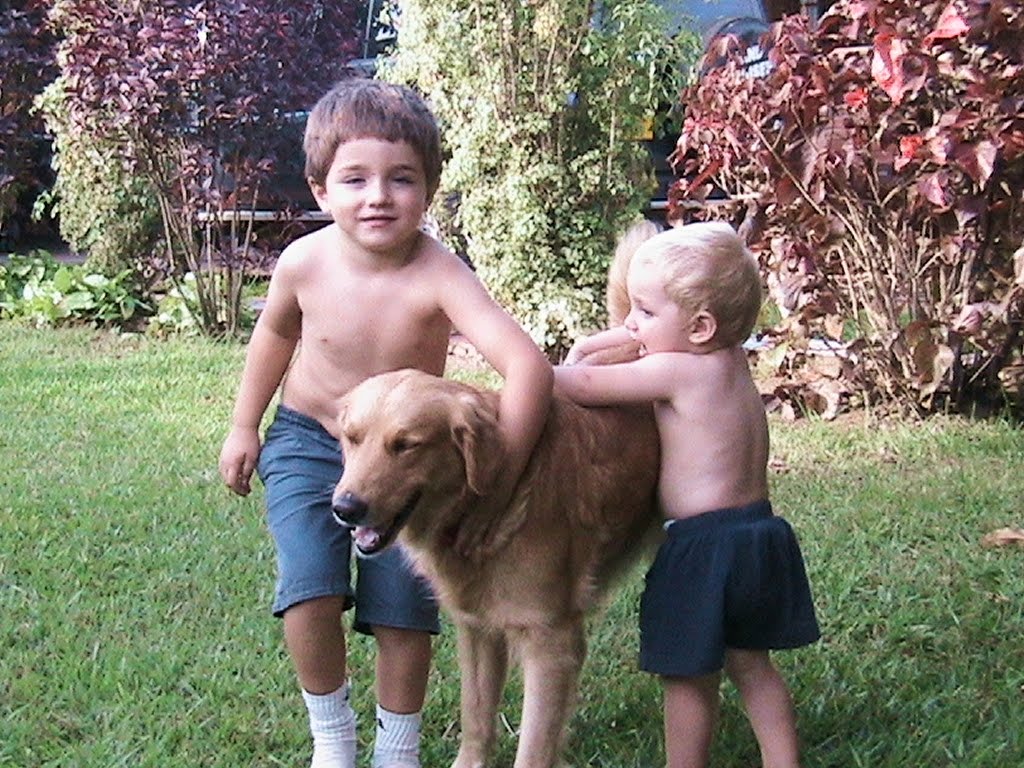
Oren and David on retreat.


Monday morning 4am.  I am having trouble sleeping tonight.  One reason is because I did not get anything posted on Sunday about the past week which really was quite full.  I can't believe what a shift in gear this has been from the week prior when it seems we were obsessed with election results.  Although the issues as far as elections are still very much unresolved, life, for us, did not wait for any outcome.

Last Sunday I mentioned Rebecca not feeling well and skipping our weekly pizza outing to Ubuntu.  On Monday morning she woke up feeling dreadful, weak, sweaty, like something she had never felt before.  Although I had been sick the week before with a nasty virus, we suspected this was not the cause.  We had malaria test kit that we decided to administer.  A drop of blood on a test strip gave a very quick positive result.  We called the doctor who confirmed that her symptoms were consistent with the test and she began treatment.  The next 2 days she might describe as some of the worst of her life.  We Americans just do not really have any idea how debilitating these virulent tropical diseases can be.  Despite beginning treatment, she could not get out of bed or barely even move.  She described headaches that felt like her brain was splitting in two.

Malaria is a terrible affliction even with good treatment, it is hard to imagine that there are children here that may contract it 12 or more times per year.  It can also be fatal, and often is if untreated.  For us though, the great challenge that this brought for us was a retreat we were planning to lead in Rwanda for our Burundian and Rwandese partners.  This is an annual event that takes a considerable amount of preparation, then a lot of energy to lead and facilitate on over the 3 days it happens.

Rebecca fell ill Monday and we were scheduled to head to Rwanda with 28 people in tow on Thursday to lead a 3 day conference.  It was a dilemma as no option sounded good.  Canceling seemed almost unimaginable after having made such extensive preparation and work to get everyone available for the date.  I considered going alone and leaving Rebecca with the kids, but in her condition that would have not been much better than being at the conference with childcare.  I even considered taking the kids and just leaving Rebecca, but I could not see how that would be possible either if I was to be the sole leader.

We decided the only thing that we could do was to pray and wait until Thursday morning to make a last minute decision based on how Rebecca was feeling.  I spent much of the rest of the week preparing to leave in many ways.  This included getting materials printed and photocopied, and solving the massive logistical puzzle of how to get everyone up there using 3 vehicles and asking some to take the bus.  (We sent the SALTers on the bus with a couple of other young partners.)

By Thursday morning Rebecca was very weak but feeling considerably better.  She was very weak, but the headache and fever were gone.  We decided that in many ways, going to the retreat was the least exhausting option as she would be able to sleep much of the time since we had 2 childcare people coming with us.

Mercifully the trip was uneventful as far as driving.  We all got across the border without incident.  This included our whole MCC team as well as many Burundians.  The place we stayed was in a town called Butare, closer to the border than Burundi. There is a beautiful Catholic monastery there called Guhindamuyaga.  The guest rooms were modest, but the grounds felt a bit like the palace of Versaille, with enormous lawns and gardens.  We got there and by 8 pm the people from Rwanda arrived there as well.  (They were delayed when the wheel of the car they were riding in fell off and rolled down the road beside them.  You get used to these kinds of things around here.)

I will try to do a synopsis of our time together, but long story short, we really had a great and meaningful time together, especially the MCC team for whom this was probably the last time we were to be together as the SALTers leave in July.  Ruth was looking great and about ready to pop from her pregnancy (they head to Nairobi soon), and it was great to have Zachee and Bridget with Timmy with us as well.  The growing MCC kid family included, Oren, Jal, Timmy who played together as well as the son of one of our partners Joshua, while David and Ella, the young kids enjoyed each other as well.  (Although Ella's favorite game seemed to be to push David down when he ran away from her.)

We try to have a theme around which we organize talks for this retreat, and this year I called it Developing a Theology of the Future.  It was a theme that I felt has relevance cross culturally because I feel the Gospel critiques both my own culture as well as contemporary African culture in an interesting way in this regard.  I will describe the summarize the premise briefly:

Normally I begin a critique of culture with my own.  I used the passage at the end of Deuteronomy where Moses is on Mt. Nebo, just prior to his death, looking over the Promised Land which he will not enter.  I considered how Moses might have felt and suggested that the view was one of great comfort to him, because his faith taught him that the best things were prepared for a future generation, not his own.  Thoughout the Bible we find this 'theology of the future.'  The hope that the best is not in the present but rather, the future.

I told my Burundian colleagues that the generation of my grandparents and even parents believed this fervently, having lived during the Great Depression and World War II.  I believe that my grandfather's maxim in life was that his children would have a better life than he did.  That kind of thinking changed at some point in the 1970s.

My generation, by contrast, believed that the best things should be ours in the present.  We were even told and assured that getting what you want now was actually a good thing, that it drove an economy from which all would prosper.  Savings was disparaged and borrowing became a moral virtue.  In the past decade, for the fist time in our history Americans have more debt than savings.

I look at us now, we are might be compared to a generation of locusts, the current financial crisis is a result of our massive wager that borrowing from the future to have it all in the present is a virtue.

This obsession with the present is not only evident on Wall St. (take what you can and get out) but is also a part of Christian Faith.  I am referring to a Gospel of prosperity that tells us that 'God wants to bless you right now abundantly, and all you have to do is ask."

But that was not the faith of my grandparents.  Certainly they believed in God's blessing, but they also believed that "I am sure that this present suffering is nothing compared to the glory that is to come."  In other words, even in our faith lives many of us have rejected the belief that the best is prepared for a future generation and not for us.

Burundi also suffers from a theology of the present.  But it has different roots.  It is based in a kind of fatalism.  After years of trauma from war the sense for most is that they have no control over what will happen to them and they and their families could be dead tomorrow.  There is no hope that a future generation will have it better than the present.  People don't think ahead, beyond finding the next day's meal or other need.  (Interestingly, the Prosperity Gospel, which we export wholesale is widely popular here as it offers a false hope that God is going to come in and solve all the problems of poverty and despair without them taking any action to change behavior or patterns of living.

In both our cultures we suffer from a sense of hopelessness (or disinterest) in the future.  And as Christians that is really tragic, because we have historically put our hopes and dreams for a future that is better than the present as a key element of our faith.  I personally regret that the word 'sacrifice' in terms of doing without or saving was really seen as 'quaint' or 'ignorant.'

I challenged our partners, in their organizations to think beyond the present or even their own terms as leaders of their organizations.  (I gave the example of my dance company, which existed for 20 years under the name Paul D. Mosley Dance Inc.) I joked that it was certainly not very future looking, as once I quit, it ceased to exist.  But I asked them to what extent their own organizations, though not bearing their names, were essentially the same thing in practice.

The talks and debates over the weekend were very interesting as well as the time to relax.  I enjoyed walking with Oren and David in the morning before breakfast.  Rebecca recuperated and by Friday was able to lead us in some times of prayer and worship with the guitar.

By the time we came back on Sunday we felt exhausted but satisfied with the work we had done.

We had dinner on Sunday with Zachee, Bridget and Tim at Ubuntu in the pouring rain.  (A surprise in this season) then we prepared for our next adventure...

We went to the airport about 7:30 pm to pick up Don and Rosaura Andujar McNeil and daughter Gabriella from Poughkeepsie, NY!!!  (For those of you waiting to hear, they did get here safely but I will write more about them next week.)

Monday, May 31, 2010

A Dog in a Tree

There is a Burundian proverb that roughly translates like this:  "If you see a dog in a tree, then you willl probably find someone nearby who put it there."  That is one of the best quotes I have heard regarding the results of the recent nationwide communal elections that took place this week.

Following election results was the pastime of most of the nation this week as well as many expatriates.  As you know from previous blogs, MCC has been heavily involved in supporting election monitoring this year.  We were really only a small part of a much larger effort, the European Union apparently had about 6000 observers here.  I had mentioned the high stakes involved in having the election appear as fair and transparent by all participants as many former rebel groups cum political parties are being held together in a democratic process by a fragile peace treaty.

The good news is  the report thus far from many observers that there was that voting was peaceful and no obvious fraud or electoral mischief was seen at the polls or counting during the course of the election.  I can also say that the day seemed almost eerily quiet and orderly.  There were no riots, or reports of widespread violence or disruption throughout the country.  The days following have been the same.

But there is something fairly unsettling about the whole event.  It seems that the party in power, reputed to be waning in popularity, won, in the preliminary count, about 80% of the vote in the communes!!  This is curious to say the least.  Stranger still, it seems that about 2.5 million registered voters cast about 4.5 million votes.  Despite this, as I mentioned above, the UN and European Union have reported that no one had observed any wrongdoing as far as the voting itself went.  So all us are left scratching our heads wondering how, in a multiparty system, where at least 5 parties have some power in the country, the ruling party could win such a stunning victory.

By midweek the opposition parties have been asking, pretty much in unity how this is possible.  The most vocal group, the radical hutu FNL even observed in some communes that they even lacked the number of votes to account for the ballots cast by their central committee in the tally.  The independent election commission is behaving suspiciously as well in all of this and has not released the official count yet and seems to be stalling.  And as of Friday, the all the opposition parties are asking that this election be annulled and a new communal election be held at the time of the Presidential election in June.

The problem remains though, no one can explain how a fraud, if there was one, was accomplished without being seen by anyone.  Where were votes added? and how?  It was in this context that an acquaintance of mine, who supports the FNL quoted me the proverb about the dog in the tree.  The question in all of our minds is this:  "How did the dog get in the tree?"  The "independent" election commission at this point is telling us to accept that he climbed up there by himself.  Possible, I suppose, but not very plausible.

Again, at this point, things have been very calm and orderly, no parties are threatening to 'return to the bush' and restart a war, but everyone has a vague sense that somehow, a fraud has been perpetrated. Despite this, the UN and EU and other international groups have given the elections the gold seal of fairness and transparency.

My own expectation is that the ruling party would win, but I am waiting to hear a satisfactory explanation of the result.  (I don't think any American would sit by and accept, without an explanation, an 80 percent majority victory by either party in a single election.)

I am worried by the general problem of the capacity of countries like Burundi to transfer power from one party to another.  At this point it would seem the current President will win another whopping majority in the upcoming Presidential election.  If we follow the history of other African nations, we can expect the Constitution to be changed during this term to allow him to run again in all future election.  (Currently the term limit is 2 five year terms.)  The party will certainly consolidate power as well and become entrenched.  I hope I am wrong about this and would love to be pleasantly surprised that Burundi is a place that makes a relentless effort to pursue truly democratic institutions.  On the good, side, all of what is happening does not seem to be falling along ethnic lines.  The ruling party is hutu, but they have made real efforts to not make ethnicity a central part of their appeal.  This has been evident in policies they have pursued in the past 5 years as well.

I am also concerned, however, about what I perceive to be of an uptick in corruption.  The price of sugar, for example, has suddenly doubled, seemingly inexplicably, and it is in short supply.  Sugar production here is government run, and there has been no crop failure of sugar cane recently.  But the price has gone up for some reason related to some shenanigans that I don't quite understand.  But someone seems to be raising capital for something.  (I won't mention the rumors here, or probably the truth if and when I know it.)

As Christians here, we, as part of our churches and small groups, have been praying (and fasting) for a peaceful election process.  At this point Christians are perplexed about how to feel.  On the one hand, the process has been extremely calm, even through this period of protest and appeal.  But the results have not given anyone much reason to rejoice just yet.

So that is my person impression of the election process. My disclaimer is that I am not claiming to be a reliable source of news and information, just an observer.

Another observation, I have made of late is that we have not had rain for about 2 weeks.  I know this to be the unmistakable sign that we are creeping once again into the dry season.  My least favorite time in Burundi.  While, generally it is warm here, and temperatures never really go about 93 degrees fahrenheit, this is generally the hottest time of year, with days in the low 90s and nights in the high 70s.  And then there is the dust.  Our poor cleaner Odifax has to mop the entire house, every square inch once per week and he still cannot keep up with the dust that covers everything.  (We have to keep the house open as we do not have air-conditioning.)  The other sad thing about this season is that it is marked by haze that completely hides the mountain ranges around us.  I will be sad to see the majestic range across the Lake in Congo disappear once again into obscurity for 3 or more months.

Many Burundians complain that this seasonal transition is particularly marked by illness, and that has certainly been true in our family.  I am been trying to get rid of a sort of sore throat and flu virus for 2 weeks now, and Rebecca has just come down with it yesterday.

The weekend was fairly quiet as a result as we laid low on Saturday.  On Sunday we did go to church and then briefly to the beach, but then we came home and Rebecca went to bed and I took the kids to Ubuntu for our weekly pizza date, this time with Travis and Astrud's family.  We again, were treated to watching a family of 5 hippos come up and graze in the marsh on the other side of the wall facing the lake.  It is awesome, like a free safari.

I did not say much about the rest of the week and it honestly did not have many high or low lights.  I feel like we have been in a kind of post-electoral haze, listening to every report and rumor that comes down the pike, hungry for some facts and a good explanation of what has happened.  I am getting used to the fact though, that 'explaining' is not a real cultural value here, and we may need to be at peace with being 'in the dark' for quite some time.

Monday, May 24, 2010

The Road to Bukavu and Other Happenings

The bridge at the border crossing between Rwanda and DRC.  Bukavu is on the right.


I swear, some weeks I have to be quite creative to make these weekly entries engaging.  Especially when a week with little going on and not much travel is always welcome here as a good thing.  Some weeks, however, this blog seems to write itself, and this is one of those times.  In fact, so much has happened that I have enlisted Rebecca to help me recall it all.

You may remember, if you have been following this blog, I was beginning the week with a trip to Congo. More specifically, I was going to Bukavu, a town that borders Rwanda and sits at the South end of Lake Kivu.  Zachee and I set out Monday morning and got there by noon.  We had lunch in Rwanda before crossing the border on foot, leaving our car at a nearby parking lot created for this purpose.  The Rwanda side is really quite beautiful with some lovely guest houses and restaurants overlooking the Lake from a high vantage point.  Bukavu from a distance looks quite picturesque.

Crossing the border on foot gave quite a different impression.  This was a busy border with many people crossing, mostly on foot.  After passing through immigration in Rwanda, we crossed a small bridge and entered DRC.  Bukavu is a town on the border and in certain ways reminded me of other border towns, I am thinking about Tijuana or Juarez Mexico.  It has a certain feel of dirt and seediness.  There are lots of petit commercants going  back and forth.  It was markedly poorer and more run down than the Rwanda side as well. 

Zachee and I got a cab and were at our guest house in about 5 minutes.  We did pass a huge number of fortified clotures of different AID organizations.  They all looked like prisons with very high walls and guard towers, but they were just the charities that do work here.  Many seemed to have names that suggested work with women and children as well as refugees. 

We met Tim Lind our MCC counterpart in Congo in the afternoon and had some very good talks about getting an MCCer placed in Bukavu that could help with programming in Eastern Congo.  We told him this was a priority as well and we would be able to give team support to someone in Bukavu as they would be very close to Bujumbura.  We are hoping an ad will be going out soon in case anyone reading might be interested in a service worker position in Congo (French and or Swahili is a must.)

We stayed the night in Bukavu and caught a cab back to the border the next morning.  I saw little there that I found particularly appealing about the town with the possible exception of a place called Café Rendezvous that was quite an anomaly.  We went in for dinner and found what I can only describe as a Seattle style coffee house, not Starbucks, but really more grunge style with sofas and people on computers and snacks like homemade chocolate chip cookies. It was run by a young American woman who spoke many languages.  We asked her if this was some kind of mission project and she said no.  She had opened it to give kids here a place to hang-out without alcohol.  We asked how she decided on Bukavu and she said she was a 3rd gen. missionary family.  Her father was actually born in the jungle and she had spent much of her life here.  …So if you do find yourself in Bukavu, this is one place I can say is worth checking out.

I was really looking forward to getting home before noon and relaxing a bit after many days of driving, (we were just in Rwanda and Burasira the week before.)  But as we headed away from the border in our car the phone rung and it was Rebecca.  She said ‘Paul we have a serious problem”.  I knew my plans for a relaxing day were not going to be realized.  I will let her pick up the story here.

While Paul was in Congo with Zachee, his son Tim came to stay at our house – for Oren and Tim to play, and for greater ease of getting Tim to school on Tuesday morning. The kids did really well together, jumping a lot on the trampoline, of course, and enjoying their dinner of hot dogs (yes you can get those here, I discovered) and homemade mac & cheese (no Kraft dinner to be found). All three boys, including David, piled into Oren’s bed for a bedtime story. It was very sweet. I was really glad Zachee’s sister Ina came to join us overnight, for another adult pair of hands to help out with the kids.

In the morning, I got up super-early to do all the morning things that Paul normally does: make breakfast, make school snacks, get the kids dressed, etc. I was almost ready to put the kids in the car when I heard a hair-raising series of barks and howls from Bella. I ran outside at the same moment as our worker Odifax came around the corner. We were horrified to see Bella fighting with a cat We had seen that cat walking along our walls before and it had occurred to us that Bella would probably attack it if it ever came in the yard.. They rolled over and over a few times before the cat jumped free and leaped up into our avocado tree. Bella chased her, barking furiously under the tree. I wanted to get Bella away, but I was honestly afraid to disrupt her hunter instinct at that moment. And then suddenly the cat dropped out of the tree again and Bella had her by the throat in an instant. I helplessly watched another short struggle before Bella killed the cat. And then we had to chase after Bella for a while to separate her from the deceased cat – I was thankful Odifax was able to do that and get her leashed to a tree. I’ve seen Bella successfully hunt down lizards, birds and rats, but this was quite differen and traumatic for me.

Fortunately, Bella just had some minor scratches on her ear, but I had real fear that she might have become infected by rabies. That is when I called Paul.  We wanted to at least revaccinate her, but feared we would be counseled to put her down.  When Paul arrived home he made an appointment with the vet right after lunch. But shortly before he was going to put her in the car we started hearing the sounds of a huge crowd passing along the main road two blocks down from us. And the crowd kept passing and passing, with singing, drumming, shouting, honking. We then learned that 10 major opposition parties had decided to band together and do a march on the final day of campaigning for the communal (county-level) elections. Paul tried to get through to the vet and he just kept running into huge crowds of people. Finally he gave up and came home again. I cancelled a playdate for the kids across town, and we just decided to lay low for the rest of the day. As Paul was driving home from teaching his dance class in the evening, the opposing traffic was sweeping the current president back home from a campaigning visit at the lower class neighborhood to our south. We heard that the ruling party demonstrations kept crossing paths with demonstrations from other parties, but that each group swirled around the other without risking confrontation. That was truly good news on an emotionally charged day. (We did succeed in getting Bella to the vet the next morning, and the vet was not really concerned, but agreed it was good to revaccinate her for rabies).

Paul again:  I can’t tell you the dilemma we felt ourselves to be in.  Bella is adored by Oren and David, and she is a great watch dog and a necessary part of our home security system.  BUT the advice we got on this type of event is to put the dog down to make sure she does not have rabies or quarantine her for 6 months.  We did take her for a booster vaccination (for which she was overdue) but we decided not to put her down.

In some ways I think our decision was fortuitously right as you will read further down.

Wednesday the US embassy had a ‘town hall’meeting for American citizens at the ambassador’s house to keep us informed on the latest intelligence related to elections and security of Americans.  They are doing this monthly now, I think. 

Frankly it is quite good to speak to them.  They were able to answer many of our questions about rumors we have heard.  The feeling is generally cautious optimism.  That is, that the elections will not be an extremely destabilizing event here but that Americans should avoid traveling around during election day and shortly after when results are announced in case there are some problems at that time.   They did also say that the bigger problem is that crime is on the increase (probably unrelated to elections.) and the new trend is to see more sophisticated gangs of armed bandits, even using Landcruisers, and wearing police uniforms and carry automatic weapons hitting businesses frequented by mzungus.  There has also been an escalation of home robberies.  We all confirmed that indeed we are now used to hearing gunfire almost every night in the city that we were told is crime related.

I had written earlier about the ‘peace dividend’ of unemployed former-rebels finding the best opportunity for income generation is this kind of crime.

The punctuation on all this is that that night our house was robbed.  From what I understand from Odifax (who was doing substitute night guard duty that night), several bandits came in and stole things that were outside the house.  To wit: my 3 favorite shirts hanging on a line, and our iron.  We heard Bella barking at one point in the night and we suspect she heard them and scared them away.  Odifax said he heard them but locked himself in the servants quarters for fear that they would force him to open the house as he has a key to the kitchen door.  (Our normal nightguard does not.)

We took this as a wake-up call to get more serious about security and have improved our protection in several important ways.
1)      We put razor wire on the back wall which abuts a school yard that is not well secured.
2)      We gave the guard a remote control doorbell that rings in our room.  And also a loud whistle
3)      The guard has our cell #s as well and can call us.  We have the cell phones by our beds as well as loud whistles we can blow.
4)      Zachee talked to our neighbor who happens to be the former minister of defense and has a detachment of soldiers guarding his house all time.  The man gave Zachee his # to give to us and said that if we called anytime he would send the soldiers over to our house.  (This is our ace in the hole.)
5)      We of course still have Bella and have suggested that the guard (Gaspard) do his rounds around the house with Bella as most Burundians are terrified of dogs and Bella is as mentioned above, quite savage when she wants to be.

All of this has given a sense of security now as we face the new realities.  One thing I know, is that an unarmed night guard would have no defense against several armed bandits so we are counting on him to play a warming function by phoning us or ringing the bell so we can whistle and yell inside, alert Bella as well as call the minister to send his soldiers from next door.

Thursday was quite quiet and pleasant.  By law all campaigning for Friday’s election ended on Tuesday.  The only problem was that I started getting quite sick.  Weakness and bad headache, and other virus symptoms but not a high fever.  I spent the day in bed.

Friday, election day, was quiet too.  Too quiet!  It was a holiday, but late Thursday night we got the news that the communal election was being postponed for a few days because of ‘ballot irregularities”  I will let Rebecca explain:

Everyone in Burundi struggles with doing things on a schedule, because of the logistical challenges here. For example, we had a tough time getting applications in for all the election observers we will be sponsoring through our partners. But on the other hand, the Independent Election Commission (CENI) was unable to meet its deadlines either. On Monday we found out that CENI would no longer prepare the badges for election observers – we would need to do that ourselves using printed materials from CENI. The materials arrived Tuesday night, and we were so grateful that our 3 SALT volunteers were able to join a team of people assembling the election observer packets on Wednesday. It was a big job for our network to support 250 people. Imagine the situation for other NGO’s, sending out up to 6000 observers! The packets were just barely ready on Thursday morning, for pick up and distribution to provinces all around the country in preparations for the Friday election. Distribution itself is incredibly complicated in a country with virtually no postal system. People just send things with friends, or with a taxi driver who hopefully hands over the goods intact at the other end. (Sometime I’ll have to list in the blog all the public service vehicles pictured in Oren’s book on transportation which are not found here in Burundi, contrasted with the vehicles that serve the purpose.)

We shouldn’t have worried so much about getting the election materials to the observers on time. The government and CENI have as much trouble as anyone meeting deadlines. Late on Thursday night we got the news that the elections had been postponed to Sunday. The reason? Voter card distribution had started late and inefficiently. Many, many people had not yet been able to get their cards and they were angry. And even more importantly, the ballots had not yet arrived in the polling stations. I think that many had not yet made it into the country from where they were being printed in Uganda. (Without making any accusation, more than a few news reports noted that the ballots for one particular party HAD BEEN distributed accurately to every polling station, but there were many mistakes on the ballots for the other parties.  (For the sake of political sensitivity we will not mention any party names in this blog.) It’s even more confusing because each party has its own ballot, and some parties have the same name. And there are at least 12 parties in the running. At this point, the election has been re-postponed to Monday because so many pastors complained about the disruption to church services.

 Paul--Saturday and Sunday were pretty normal.  Rebecca prepared music for the afternoon service on Sunday and David really wanted to help as you can see above.

After church in the morning we had lunch with some German Friends who work with Germany’s development organization GTZ.  They are parents of one of Oren’s classmates.  It was really interesting and enjoyable to go over there.  We had filet mignon for lunch and then enjoyed the pool in their yard.  Their house and yard is palatial with a great view that overlooks the City.  It was like a day at a resort.  It is always interesting to go out and see how the ‘other half’ lives.  (That is non-missionary expatriates.) 

We ended up on Sunday evening again to have dinner with Tim and Jeanette our South African friends then headed home about 8pm along the Lake only to find an enormous hippo walking along the side of the road.  Thank God for high-beams!

Bonus photo: another Oren original, he seems to be into these sort of Andew Wyeth looking tableaux--muted colors, light reflecting on surfaces, --studied, formal composition.

Monday, May 17, 2010

Farewell to a Faithful Friend and Coworker


Oren and David cultivating Jodi's garden with Rebecca and Jodi.


Another  late Sunday night blog entry but I really want to finish this before morning because I am heading to Congo tomorrow and I want to post something for this past week before writing about the next one.

I suppose I should begin with the sad news.  Many of us have lost an old friend, a trusted companion, a faithful coworker.  This week I stood by helplessly while my trusty Mac book suddenly and unexpectedly suffered what I can only call a massive stroke and died.  I cannot just say it was a computer.  It was truly an extension of my memory and an archive of many years of work in my life, not to mention contacts, family photos, and thousands of pages of writings from grad school to the present.  Not that much of this isn’t backed up, but none of it is convenient, in fact some is on the other side of the world.  So there is a real sense of loss here. 

It happened, as I said, very suddenly.  I was turning on an iTunes movie for David and it suddenly froze.  When I restarted it, a white screen came up with a ? on it.  I did all the procedures I could by way of first aid, but to no avail.  It appears that the entire OS is corrupted.  I would have remained mystified by the cause, but I talked later this week to Robyn who used the same Chinese power strip my computer was plugged into.  She said hers was acting haywire and she unplugged it.  So now I have both the loss and the guilt that I probably fried my own computer. 

So this was a sad week and I hope that some data might be recoverable from what might be left of the hard drive, but I won’t know that until we get home to the US for 4 weeks this summer. (mid-July to mid-August.)

This happened on Monday evening.  Fortunately it was not indicative of how the rest of the week would go.  In fact, if anything, it did give me pause to consider the things I am grateful for.  Our family is in good health right now and I have been aware of how this job has been such a great opportunity for Rebecca and I to share both work and parenting, AND for us to share our work with our children.

This happens especially when we go on field visits.  This week we decided to combine two trips into one by going to Kigali on Wednesday, spending 2 days there, then heading home through Burasira to visit Jodi. 

The visits were all very good.  We headed out to Kigali in the afternoon and arrived about 7:30 pm.  We had forgotten that it now gets dark around here as early as 6pm, so the last hour or so was slow going.  (People walk along the edge of the road and they are almost impossible to see.)  We did have a good visit with Ruth and Krystan though.  We just missed the SALTers by a day who had come up for a visit the day before to see some of MCC Rwanda’s projects.  They also got to enjoy visiting with Ruth and Krystan as well. 

We came here with a load of baby supplies as Ruth and Krystan are expecting.  (It is not a secret anymore.)  They are, at this point planning to go to Kenya for the delivery of the baby then return to Rwanda.  (I do not remember the date.)  In a way, this should eliminate the complications arising from the timing of the baby corresponding to the Rwandese Presidential election.

We also visited our partner Friends Peace House and discussed the upcoming election.  Generally people are quiet and afraid. That seems to be one of the main contrasts right now between Rwanda and Burundi.  Whereas Burundi has 44 political parties vying for power, Rwanda effectively has one.    In Burundi we are seeing daily political rallies as large groups of partisans sing and shout their loyalty to their party, in Rwanda it is pretty quiet. But in both cases I do sense that fear, not excited anticipation is the real motivator of activity or lack thereof in these two countries.

I have come to understand the anxiety that accompanies an election in these Sub-Saharan African countries.  I mentioned last week that most political parties are former militia groups.  But also, voting is often either a matter of coercion or bribery.  People vote in order not be killed or because they have been paid to do so.  (Often beer is a good form of bribery.)  In fact, one student intimated to me, that the large political marches for different parties that I see, are often made up of the same people who have been offered some form of reward for participating. 

All this to say that beloved as we hold our western ideals of democracy, we are naïve to think that exporting them leads to pluralistic societies where all voices are heard.  Often, I think, it simply legitimizes a tyrant in the eyes of the international community. 

But perhaps I am being too cynical.  At any rate, MCC is doing its small part to make sure that the voting process is transparent when it happens.  In fact Ruth and Krystan were in the process of writing a grant to the Canadian embassy to help get funding for some election monitoring training for the Friends Church.

It was a good visit and Ruth and Krystan seemed to be doing very well.  Oren and David were, of course, thrilled to be at the guest house where we usually stay, and even liked shopping at the big mall with the Nakumat supermarket, which is the closet thing to an American supermarket we have in these parts.  We stocked up on items we can’t get easily in Burundi and left Rwanda on Friday morning with our loaded with supplies for us and Jodi as well.

The drive to Burasira was surprisingly smooth.  One  of the terrible dirt roads we take coming from the north to get to her house had been graded recently and we got there in good time with relatively little back pain.
Oren and David were again thrilled to visit her house, especially since it is right next to the side of the seminary where they keep livestock.  It was hard to restrain David from running out the gate every hour to see the cows, rabbits, and pigs in the nearby stables.

We also caught frogs and other smaller animals to play with.  (The frogs are often in the house in the morning and one has to be careful when walking around barefoot in the morning not to step on then.)

Two things that are great passions of Rebecca’s that are being inherited by the children are the love of gardening and bird watching.  Oren and David spent hours digging in the garden, weeding, filling the compost pile, pulling carrots and doing other garden activities while they were there.  They were covered with mud most ot the time.  The only problem with that being that Jodi’s house has no hot water, just icy cold for bathing.  And the climate upcounty is considerably cooler than Bujumbura.

On Saturdy night we had dinner with the priests as we have not had occasion to do so for quite a while.  It was very nice to see them and they were delighted to see how much the kids had grown.  Oren was quite polite and greeted them all in French and shook hands as is the proper Burundian custom.

We headed back down to Bujumbura Sunday morning and got home around 2.  We met Yolanda and Robyn who were housesitting for us and debriefed us on their Rwanda trip and the field visits they did.  They had had a great time and had bought some local pottery, baskets, and fabric, much of it from groups that were doing income generating activities through our partners.

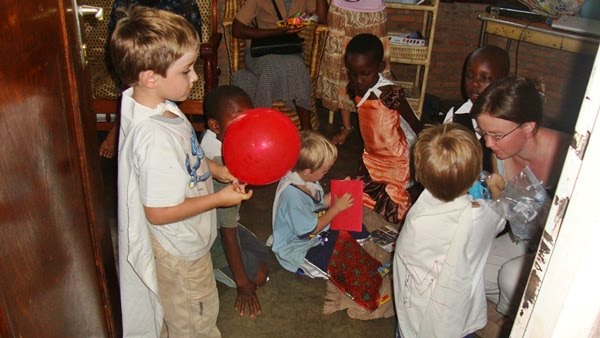
In the afternoon we went to a birthday party for Zack Johnson, one of Oren’s friends.  The kids had a lot of fun and the party had a superhero (Batman) theme.  Among the activities was a decorate-your-own cape contest, (which they wore for the rest of the party) as well as a piñata, scavenger hunt, and Batman birthday cake. 

Jesse Johnson’s family has been in Burundi for about 4 genereations so he grew up here,  He speaks fluent Kirundi and is a great resource for cultural information about the country and its people.  I always enjoy the chance to visit them.

We got back to our house bathed the kids and put them to bed.  David was far too hyper to go to sleep.  He is really an extremely enegetic little guy who would happily spend the whole day jumping on the trampoline and running around in the yard well into the night if we would let him.  (Oren usually konks out about 8:30).  But the nice thing to see is that they can play together now and seem to enjoy doing so.  This was helpful when we were trying to talk with Jodi or Ruth and Krystan during our field visits.

It is late and I need to get to bed.  Monday morning I head off to Congo (Bukavu) with Zachee after dropping Oren off at school.  I regret that this visit falls right on the heels of our last trip as my back is a serious mess.  I never would have guessed that the greatest work hazard of a missionary is a slipped disc and severe back pain, but driving landcruisers over terrible roads is really taking its toll.  I will be glad to get back to Buj for a swim on Wednesday.


In Memorium
Paul's Macbook 2007-2010, 
RIP

Monday, May 10, 2010

Mother's Day Week

Oren and David, after painting their faces spent Saturday morning playing with Bella.  They are especially happy that she is well and healthy again.  They are excited about the possibility that we will breed her in the future and she will have puppies!


We have enjoyed our third and final consecutive week of no travel.  We will be going to Rwanda this coming week and coming back home via Burasira to see Jodi.  I am trying to think back over the highlights and not many come to mind.  I have been in the habit of calling such weeks 'blessedly uneventful' and I continue to see them this way.

One thing we have seen happening this week that is a change was the official launching of the political campaign period.  I believe it was Monday or Tuesday.  Here in Burundi, political campaigning is tightly regulated.  Parties have not been allowed to actively campaign and promote their candidates until now.  It is interesting because it is only about 2 weeks from the communal election and 2 months from the Presidential election.  I have to admit, the first day was more than just a bit scary.  Suddenly the whole city was full of parades and carloads of screaming partisans marching up and down the streets or careening about the roads.  They were fierce and angry and moving about like mobs.  Fortunately all political campaigning cannot begin before 8am, I believe and must end by 6pm.  So while it is better at night, right at 6 the streets are filled with very drunk people making their way home in large groups.  (I don't know why but campaigning and drinking are intimately linked here.)

Seeing the large groups of shouting mobs moving about the street carrying flags of different political parties reminded me of the fact that until recently, most of these political parties were in fact, warring rebel groups, and it has only been the Arusha Peace Treaty that has brought them to agree to fight each other with votes rather than bulllets.  But because of this, I do worry about 'sore losers' and the temptation to use defeat as an excuse to take up arms again.

( I am reminded a bit of some of those great 'break dance' movies in the 80s where rivaling LA gangs would decide to settle their turf wars with break dancing and rapping rather than guns.  Yeah, that would probably happen.)

So I do pray that this election process goes smoothly and that people will restrain themselves from dragging Burundi back into war.  One thing that is clear, an election that is perceived by anyone to be fraudulent will be more likely to lead to a violent reprisal.  That is why MCC and other groups have been working very hard to train and field election observers all over the country.  We should be able to train about 200 and many members of our own team are going to be acting as international observers.  (Rebecca will be observing for the communal election coming up.)

Other than that, work has been at a bit of a low ebb.  We are well past the beginning of the year, but not yet to the time of progress reports.  We do keep in regular contact with our partners because most of the election observers we are fielding are coming out of partnerships.  It has actually been a really good opportunity to create networking opportunity between partnerships, AND has been a chance to do something that is not simply a matter of handing out money.

I have been thinking a lot about foreign aid these days, especially in terms of giving out money.  I am, as I have written in the past, more and more convinced that this kind of intervention is doomed to failure here in subsaharan Africa.  Sadly this extends even to aid to churches.  While I am not purposing that it be cut off completely, it needs, in some way to be connected to structures of accountability and entrusted to ‘servant leaders.’  As I have said before, in this country a pastor is a position of tremendous power and influence and is often perceived to envied as a post where one has great access to resources (the church’s bank account) and little responsibility (outside of preaching).  I am thinking of what a contrast it is to the perception of clergy in the US who are often doing an thankless job for a low salary, and little ‘status’ as far as how they are perceived by society at large.

But here, especially in the upper echelons of leadership, it is not uncommon for succession in a denomination to be a time of turmoil complete with death threats, assassination attempts, in the struggle to gain a coveted position of power.  This is, I think, one of the big shocks about mission work in this cross cultural context.  We come with a lot of assumptions, but one of our biggest prejudices as Christians is often the belief that ‘doing the Lord’s work’ is perceived by all to be a selfless, sacrificial vocation.  But in a country where there are few jobs, economic investment, and other opportunities, church leadership and other foreign aid related professions are sought after by many who are ambitious, self-serving, and more than occasionally, unethical.  (I am not implicating all leaders, by this, but I am observing that this problem frequently exists at the level of leadership here.)

By contrast though, what I find at the laity level, is that churches here are vibrant and spirit-filled.  What is lacking in financial resources seems to be paid back double in terms of spiritual blessings. I am always amazed by the number of choirs singing jubilantly in a single service.  (This accounts for the reason that they are often so long.)  So, to be clear, my disappointment with church leadership and the ineffectiveness of faith-based foreign aid to reach the truly vulnerable is not meant to be an indictment of the church as a whole.  In truth I believe the church here is one of the few really effective networks to mobilize the population for a better future for this country.  BUT that effort needs to come from within, not an agenda sent with a big bankroll from first world nations-even well from well-meaning, people.

Long diatribe, but I am back on track to finish the week.  Actually the weekend was definitely the highlight.  Oren’s school decided to have its spring fete early.  It usually happens close to the end of school, but I think the administration has wisely observed that many of the NGO and UN mzungus are fleeing the country with the approaching elections and they are worried that there will not be many left before the end.  (In fact, the end of school was moved up several days so that it would be before the Presidential election on June 28th.)  The fete was a lot of fun, (especially if you like to hang-out with Belgians) and every class did a little performance.  Here are some photos of Oren’s class who sang a song about a drum and Oren sat on one in front and played it. (Other photos on the blog are from the fete.)  He did look a bit nervous for some of it, but we enjoyed it a lot, especially David.

On Sunday Oren got up and made a mother’s day card for mommy.  He loves to paint and do crafts, so he took some time to do a water color of our whole family, including Bella.  We went to church, both in the morning and afternoon and ended the day by going to Ubuntu with Joy and Jesse Johnson and their 2 kids Zack and Micah.  They all enjoyed playing together and we were treated to seeing a family of hippos on the lake, Mom, Dad, and a baby splashing around just over the wall of the restaurant.  It was a great way to end the week.

This Monday is turning out to be busy as I am finishing up this blog and trying to get car documents to go to Rwanda and a visa for Congo as I will be going there the week after this one.  Please keep us in prayer.

Monday, May 3, 2010

#100

The pictures in this week's blog were all taken this past Friday afternoon when we visited Cercle Hippique after Oren's French lesson.  David and Oren love to see the horses.


It is hard to believe, for me, that this is the 100th blog entry I have published since I began writing these posts 2 years ago.  We are fast approaching the end of our second year here, and I all I can say is that time flies.  Actually time does go faster as you age.  When I was a child, 2 years was a good chunk of my life.  Now it is not hard to imagine planning holidays in detail 2 years in advance.

When I look at the hit counter at the bottom of the page, it does seem to indicate that a fair number of people read it every week, and I sometimes wonder who I am writing this to.  Do I have a picture of who reads it?  I could say I write it for myself, but truthfully there is some sense in me that I am writing it for my children. I tend to see a lot of our experiences through Oren’s eyes, and I do imagine him someday, as an adult, going back and reading about his childhood in Burundi.  (David too, of course but Oren is old enough to remember right now.)

This week was another blessedly routine one.  We were in town all week and able to stick to our routines.  I swam every morning before work which gave me real patience for the things we had to do.  I continue to do Kirundi lessons on Monday afternoon and I have to say, after 2 years, I am beginning to feel a breakthrough.  It is still difficult to understand what is being to said to me, as there are so many ways of saying the same thing, but I can now say just about anything I want to. 

It is kind of amusing because the text, which is very good, was written by a missionary and much of the vocabulary has an evangelical thrust, especially at the beginning.  Many of the early exercises were translations of sentences like:  “The old man has many sins, he needs to repent.” There was also a lot of vocabulary based in rural life so I learned very early how to say “My parents are hoeing in the garden.”   (I was always waiting for the opportunity to use that phrase.  Actually my in-laws do more gardening so I did have the occasion from time to time to say: “My wife’s parents like to hoe in their garden.”  Abavyeyi b’umugore wanje barakunda kurima mu murima yabo.  But now I can say considerably more than that. And I try to use it when I talk to people.  I find it particularly helpful to talk to the many people who ask me for money, especially children.  I will say that often they are so taken aback that a mzungu is speaking Kirundi that they are incapable of answering.  (strange but true.)

The last thing I will say about the language is that pronounciation is VERY important as many of the same words mean very different things.  The most striking example of this I have come across is the verb kumaramara.  Depending on the pronounciation “ndamaramara” can mean eiher “I am finished (the job) completely.’ Or “I am deeply ashamed.”  I don’t know if I should read too much into the fact that finishing completely and being ashamed are the same word. 

Enough Kirundi lessons.  The other thing I have been doing a lot of this week is thinking about Eastern DRC (Congo).  As you might know, Burundi borders Eastern Congo and the border is about a 30 minute drive from our house.  And yet we have never been there.  There are several reasons for this, but the main one being that Congo is out of our jurisdiction as MCC reps.  MCC Congo, based in Kinshasa administers the whole country.  The problem is, unlike Burundi Congo is enormous.  Kinashasa is about as far from Eastern Congo as Denver is from Washington DC.  And there are viturally no roads connecting them and almost no direct flights  

So it is hard for MCC Congo to administer the whole country.  After our regional meetings, we have been talking about ways that MCC Burundi might be able to share or support the work in Eastern Congo with MCC Congo.  I am hoping to visit there 3 times in the next two months to meet with the MCC rep there while he is in the east. 

If any of you have read anything about Eastern Congo you would have to agree that it is the most God forsaken part of the world ever.  It is sadly, rich with some of the most valuable minerals in the world, especially Coltan which we all have in our computers and printers.  But it is a region of terrifying lawlessness as a result as many groups are trying to extract it, mostly illegally.  This even includes the Rwandan army as well as the Congolese army.  But hidden in its jungles are also numerous murderous rebel groups including left over fugitives from justice who started the Rwanda genocide (Interahamwe), tas well as the terrifying Lords Resistance Army know for abducting young children and turning them into 4 foot killing machines.  Eastern Congo is also now considered the rape capital of the world and rape is systematically used as a way to terrorize the population there.

In spite of all this, the President of DRC (Congo) Joseph Kabila is very keen on having the UN peacekeeping force out of there by July and wants the Congolese army (sometimes implicated in the same kind of activities listed above.)to take control.  I shudder to think what will happen if the UN leaves the region.

All that to say, there is real need for MCC work such as trauma healing and reconciliation training.  I am hoping, that we might be able to get an MCCer stationed in Bukavu, Uvira, or Goma who could work collaboratively with MCC Burundi and Congo.  The challenge is, of course, recruiting someone who would be willing to work there, but also trying to work in the unbelievably corrupt context of Congo where paying off everyone even for humanitarian work is business as usual.  If you are not up to date about problems in Eastern Congo, it would be worth it to find out more and even advocate for more attention to this region of the world.  It is like a bizarre secret as it is considered to be the world’s deadliest regions, an estimated 5,000,000 people have died there in the last decade as a result of war, lawlessness and violence.  That makes Iraq and Afghanistan pale by comparison. 

This has definitely been a bit of a good news/ bad news week.  The good news is that Bella, our dog is well.  She was quite sick last week and we really began to worry about her over the weekend.  I decided to track down a vet and was glad to find there is a veterinary clinic in Bujumbura.  It is not like the US where clinics are well appointed and full of pet toys and other merchandise.  It was basically a row of examining tables.  There is really no diagnosis, and treatment is just a bevy of shots, dewormer, antibiotic, multivitamin.  But the combination did do the trick and Bella is better again.  The episode did make us realize how much we appreciate having the dog though.

This was punctuated even more when we found out that our other volunteers here in Bujumbura, the Horst family, were robbed this past week.  Bandits jumped over the wall and stole numerous items that were outside the house.  (They did not break in.)  It was done in stealth.  The nightguard was questioned and he insisted that he missed the theft as he was in the back doing the ironing very intently.  The truth of his testimony drew some suspicion as he would have had to have been so concentrated on his task that he did not notice that both the iron AND the radio he listens to when he irons were taken in the heist.  He later insisted he was in the bathroom, but it is clear he was asleep. 

I think most nightguards sleep on the job, and that is why a dog is such and essential part of the alarm system.  A dog will wake up everyone in the house and also is a great deterrent as people here generally have a great fear of dogs.  We are now working to help our volunteers have better security for their house.

The weekend was very relaxing.  We spent Saturday afternoon at the pool where David is making great strides in being able to stick his head underwater.  He just cannot get enough of the pool.

Sunday was also very nice.  Rebecca and I taught Sunday school together in the English service.   We did a lesson on the Holy Spirit leading us.  When I read the story of Phillip and the Eunich in the book of Acts I opened the Bible to find a mysterious envelope.  I read it and it sent us on a treasure hunt.  We went all over the rainbow center grounds following clues and ended up finding Rebecca.  She played the Eunuch and I was Phillip.  It was pretty cool.  (We probably have been watching too many Dora the Explorer videos with David.)  We ended the class with a trust exercise where people are lead around an obstacle course blindfolded that I used to use in teaching dance and improvisation class.  (the guiding technique is to have the blindfolded person gently touch with 1 finger the up turned palm of the guide.  By the subtle movements of the hand as the guide leads them around, they know which way to turn.  The lesson is that they are drawn, not forced to choose a path by the Holy Spirit.)  The kids really got a lot out of the lesson and loved it.  I hope we can be that creative in the future.

That is it for now.  I have to take Oren to school.  Hey, since this is posting #100, maybe some of you could post a comment to let me know that you are reading this, where in the world you live, and what things you like to hear about.  I am curious.  (FYI when you post, your email and name to do not appear so do not assume I know who you are unless you say so in the comment itself.)

Monday, April 26, 2010

Malaria and Other Seasonal Challenges

Although it has been a fairly relaxing week, for some reason I was so exhausted Sunday evening that while I was rocking David to sleep about 9pm, I found an unbearable urge to join him in slumber and went to bed shortly after without doing the blog.  I have committed myself to doing this weekly so I am starting it now on Monday morning.

We have been developing a Sunday routine that is really giving some meaning to Sabbath.  Generally we do not work at all on Sunday, but go to church at the Burundian fellowship PTI in the morning (usually goes from about 9 to 12) then we either go to the beach or home for lunch and play.  We enjoyed lunch on the porch yesterday after a very thoughtful sermon on the ‘discipline of giving.’  Probably most interesting were the questions afterwards about what this means in the Burundiain context.  Not so much that people are poor, but that there is already tremendous social pressure to give any surplus to the many needs of family, friends, etc, for any number of reasons from weddings and funerals to business loans. 

This in turn gives one leverage in the community to ask for money when these needs arise for them.  But this network makes giving in the sense of true charity difficult.  (That is giving in which nothing is received in return.)  Mzungus get sucked into this network as well.  Rebecca and I are, on a daily basis, asked by strangers, friends, staff, partners, etc. for gifts or ‘loans’ for any number of projects.  I feel in many ways we are far more ‘generous’ than we were in the US simply because a lot more people ask us for money. 

BUT I honestly cannot say I feel particularly good about giving away money this way.  First because we are not really part of this social network, so we don’t really have a quid pro quo relationship with these people in quite the same way.  Secondly, I really feel that this money reinforces a dependency relationship and reifies the belief that white people and white people’s money is the answer to the challenges in Africa.  I would say that the more I am here, the more I believe the opposite to be the case.  I have seen very few instances where financial inputs by us, have brought about sustainability or long term transformation in anyone’s lives.

A long diatribe to say that the sermon has encouraged Rebecca and I to rethink our giving and we have decided to be much more intentional about where we give and why.  We do, for instance want to support the vision of the fellowship we participate in.  We also do want to be able to help our staff take care of their families, but also build their capacity.  We are helping 2 of the 3 with education at this time, and that feels like something valuable.  The big challenge will be to say “no’ a lot more to the many legitimate needs that are brought before us that really should not be solved with a quick fix from a rich mzungu.

(continuing with the day)  Sunday afternoon we went to the English fellowship where Oren goes to Sunday school.  One thing I like about this fellowship is that I get to play the djembe when we sing from time to time.  We also help out with the Sunday school. 

The latest addition to our Sunday routine that is really enjoyable is after the English fellowship we head over to Ubuntu, a restaurant overlooking the lake, where they have half price pizza and drinks between 5 and 7 every day.  We are making this a weekly tradition and we usually invite friends (like Zachee, Bridget, and Tim) to eat with us.  What is nice about it especially are the enclosed grounds complete with crowned cranes, turtles, frogs, and even some cats, as well as large rocks and palm trees that makes a fabulous natural playground for the kids to entertain themselves while adults talk.  (We occasionally see hippos on the lake here in the evening as well.)

Yesterday we were there alone because Bridget was recovering from malaria  (It also rained while we were there).  It was still a nice time though with the family sitting under an open pavilion watching the rain fall and enjoying the cool breeze.

This is the rainy season and that means it is malaria season.  I consider it almost a miracle that no one in our family has succumbed yet since we have been here.  We are diligent about using mosquito nets at night, which I think is the most effective preventative measure.  We are no longer taking malarial prophylaxes as we did not have good feeling about taking larium weekly for 5 or more years.  But that has meant we really need to use those nets.

Malaria has been the cause of a great deal of absences of our house staff the past three weeks.  All have had malaria and have missed one or two weeks of work at a time.  This has made life challenging as we have had to do a lot of cooking and shopping, and cleaning on our own.  (I know that does not sound too hard, but in a place where there are no supermarkets or prepared food, even making a pizza means you start with tomatoes, flour, and a wheel of cheese). 

We did take some advantage of this on Saturday when Oren asked to do a cooking project.  He had found some cookie cutters and asked if we could make Christmas cookies.  I found a Betty Crocker recipe for sugar cookies and confirmed we had the ingredients then made them together.  He loves to do projects, be they crafts or cooking.  David was happy to eat, but also wanted to get on the table and help as well, much to Oren’s chagrin.

The big news for Oren though, happened on Friday and I am sorry I have no documentation of the event.  We were at Entente Sportive, the swim club, after work with the kids and some of their school friends.  Oren suddenly decided he wanted to jump off the 3 meter platform.  (There are 2 three meter platforms and a five meter platform on the deep end of the pool.)  I went over with him, and after about 30 seconds of looking down, he jumped off.  He came up out of the water with a tremendous look of triumph on his face and went back up and did it 5 more times. (One of the 'perks' of living in a third world country is that there are no safety rules governing such things as 4 year olds going on high diving boards.)

He loved it so much that he wanted to go the next day and do it again.  When we went Saturday though, he suddenly got afraid and refused to jump.  It was sad because I brought the camera then and was going to put a picture of him jumping in.  Maybe we will try again next weekend.

I seem to be working backwards through the past week and I will just say by synopsis that the work week went well with much of our work focused on election preparations (see press release below).  One thing worthy of note has been a teachers strike in the Burundian public schools. 

The teachers are on strike because they have not received their full salaries.  I am not exactly clear why, but it is a typical problem for govt. employees here.  The Belgian government even gave a grant to pay the salaries so the teachers could go back, but it seems the government squirreled away that money for other things.  (another typical problem.)

Now however, after more than a month of this strike and exams coming up, the public school students have decided to call a strike and to demonstrate against an unfair disadvantage they will have going into national exams vis-à-vis private school students who have not missed any classes.  (Apparently the national exams will happen as scheduled despite the extended teacher strike.)

So the public school students have been preventing private school students from going to class by going to the schools in the morning at throwing stones at them at school entrances this past week.  They have effectively shut down several private schools.  (Including the one behind our house.)

It is really sad to me to see another example of a completely broken system here.  Honestly, as I look more and more deeply at the problem of poverty I find less and less a spirit of compassion in me but rather a spirit of anger.  This is probably the second phase of being a foreigner in this context.  Underneath the suffering one almost always finds, not misfortune but structures of injustice that keep the poor miserable and stuck, while the wicked prosper.

And I won’t be simplistic, it is not a simple matter of wealthy first world nations raping the land and people, these structures are at every level and know no racial boundaries, they exist in the world, nations, states, communities, neighborhoods, households, and families.  The vulnerable have no power at all these levels and transformation has to happen in all of these places.  A change from the top will not change the injustices at the levels below, nor am I convinced that a change from the bottom necessarily will bring about change at the top.  It is a challenge to know where we can enter to bring about change that transforms all.  But it does reaffirm my belief that such work for change requires a supernatural patience and hope. 

I am thankful that our work here is through an organization that recognizes God as the agent of change, and we have the patience and hope that only a faith that extends beyond our individual lives can engender.  That said, I think I will end here.

I am including below a press release Rebecca wrote for our activities in Burundi related to election preparations.

MCC joins efforts to prevent election violence in Burundi
Rebecca Mosley
April 23, 2010

BUJUMBURA, BURUNDI – Burundi, still recovering from a 15-year civil war, is bracing itself for national elections in the summer of 2010. Past elections have triggered violent ethnic conflict; the current elections are a real test of Burundi’s progress towards ethnic reconciliation and power sharing. Burundi, one of the 10 poorest nations in the world, desperately needs a sustainable peace in order to concentrate on much-needed progress in education, health care, agriculture and development of infrastructure.

MCC and its local partners have joined together with other organizations from the historic peace churches as the Quaker Peace Network (other international members include American Friends Service Committee, Norwegian Quakers, and African Great Lakes Initiative; 7 local Friends NGOs are also key members in the network).They are recruiting and training election observers to help promote free, fair and transparent voting. They have also joined with a larger nationwide network to prevent election violence. Key people have been handpicked from every corner of the country to report incidents of election violence—as well as note pro-active work for peace. They aim to map any incidents to better understand causes of violence and work at resolving conflicts before they explode. A reliable network of information will help dispel the kinds of rumors which led to the violent conflagrations of past decades.

This network for preventing election violence, “Amatora mu Mahoro,” was launched on Friday, April 23. The president of the National Independent Election Commission (CENI) presided over the event, and gave high praise to this effort to change history in Burundi and safeguard a peaceful electoral process.

“Amatora mu Mahoro” has widespread support across Christian denominations. The Quaker Peace Network represents some of the protestant actors. But the closing speech was given by the Catholic Archbishop of Bujumbura. In a wonderful gesture of rare ecumenical cooperation here in Burundi, Msg. Everiste recognized that Christians of every confession have already decided to pray hard for these elections. “But not simply to pray. They have decided to work for peace with the faith that moves mountains.”

MCC Burundi is a small program with few financial resources. But it has supported these peace efforts through the rich relationships it has formed with partners in Burundi. It has been able to connect local grassroots peace activists – from University peace commissions to elders of village reconciliation councils – with these national efforts. In this way, the national network has access to reliable local information and people of integrity in remote corners of the country. And local peace builders are empowered to play a role in the national effort to solidify peace in their country.